

Practical Steps to Calm Your Mind and Feel More in Control
If you find yourself constantly replaying conversations, worrying about what might happen, or struggling to switch off your thoughts, you are not alone. Many people search for how to stop overthinking because it can feel exhausting, overwhelming and difficult to manage.
Overthinking is not a personal failure. It is often a response to anxiety, stress or past experiences. The good news is that there are practical and effective ways to learn how to stop overthinking and regain a sense of calm and control.
This guide will help you understand why overthinking happens and provide clear, step by step strategies you can begin using straight away.
Table of Contents
- What is overthinking
- Why overthinking happens
- Common signs of overthinking
- The overthinking cycle
- How to stop overthinking step by step
- Practical techniques you can use daily
- Common mistakes that keep overthinking going
- How therapy helps with overthinking
- Getting started
What is overthinking

Overthinking involves repeatedly analysing, worrying or replaying thoughts in a way that feels difficult to control. It often includes thinking about past situations or imagining future outcomes.
When people look for how to stop overthinking, they are usually experiencing thoughts that feel stuck or repetitive. These thoughts can focus on mistakes, decisions, relationships or uncertainty about the future.
Occasional reflection is normal. Overthinking becomes a problem when it starts to affect your mood, your sleep and your ability to focus.
Why overthinking happens
Understanding why overthinking happens is an important part of learning how to stop overthinking. It is often linked to the brain trying to protect you.
Your mind may believe that by analysing situations in detail, it can prevent mistakes or reduce risk. In reality, this process can keep you feeling stuck.
Overthinking is commonly linked to anxiety. When your nervous system is activated, your brain searches for answers and certainty. This can lead to loops of thinking that feel difficult to stop.
Past experiences can also play a role. If you have been criticised, judged or experienced difficult situations, your mind may try to anticipate and avoid similar outcomes.
You can find more information about anxiety and recommended treatments through the NICE guidelines.
Common signs of overthinking
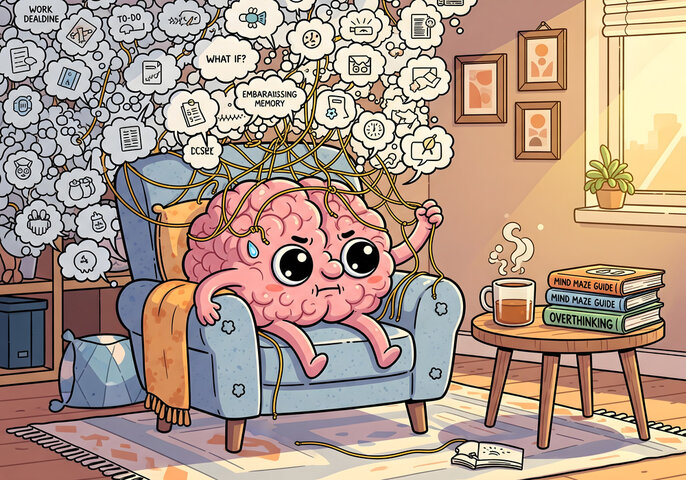
Recognising the signs can help you begin to understand how to stop overthinking.
- Replaying conversations repeatedly
- Worrying about future scenarios
- Difficulty making decisions
- Struggling to switch off at night
- Constant self doubt
- Feeling mentally exhausted
These experiences are more common than you might think, particularly when you are feeling under pressure or uncertain.
The overthinking cycle
Overthinking often follows a predictable cycle. A situation triggers a thought. That thought leads to worry. The worry leads to more thinking. This creates a loop that can feel difficult to break.
Learning how to stop overthinking involves interrupting this cycle rather than trying to eliminate thoughts completely.
The goal is not to stop thinking. It is to change your relationship with your thoughts.
How to stop overthinking step by step

There are practical steps you can take to begin reducing overthinking. These work best when applied consistently.
Start by noticing when you are overthinking. This might sound simple, but awareness is the first step towards change.
Next, gently label what is happening. You might say to yourself that you are overthinking. This helps create some distance from the thought.
Then, shift your attention to something in the present moment. This could be your surroundings, your breathing or a simple task.
Allow the thought to be there without trying to solve it immediately. This reduces the pressure your mind feels to find an answer.
These steps form the foundation of how to stop overthinking in a manageable and realistic way.
Practical techniques you can use daily

Set a thinking time
Instead of trying to stop thoughts completely, set aside a specific time each day to think about your worries. When thoughts arise outside of this time, gently remind yourself that you will return to them later.
Focus on action
Ask yourself whether there is a practical step you can take. If there is, take it. If not, acknowledge that thinking more will not provide a solution.
Use grounding techniques
Bring your attention back to the present moment. Notice what you can see, hear and feel around you.
Limit reassurance seeking
Constantly asking others for reassurance can keep overthinking going. Try to sit with uncertainty for short periods and build this gradually.
Write your thoughts down
Writing can help organise your thoughts and reduce the intensity of overthinking.
These techniques are practical ways to begin learning how to stop overthinking in everyday life.
Common mistakes that keep overthinking going
When trying to learn how to stop overthinking, it is common to fall into patterns that unintentionally maintain it.
Trying to force thoughts away can make them stronger. The more you try not to think about something, the more your mind brings it back.
Seeking constant certainty can also increase overthinking. Life naturally involves uncertainty, and learning to tolerate this is an important part of change.
Being overly critical of yourself can add another layer of stress, making it harder to step out of the cycle.
How therapy helps with overthinking
Therapy can provide structured support in understanding and reducing overthinking.
At MindKey Therapy, approaches such as Cognitive Behavioural Therapy help you identify patterns of thinking and develop practical strategies to respond differently.
Therapy also supports you in understanding the underlying causes of overthinking, including anxiety and past experiences.
You are guided at a pace that feels manageable, with techniques tailored to your individual needs.
For more information about evidence based therapy, you can visit the BABCP website.
Getting started
If you want to begin learning how to stop overthinking, start small. Choose one or two techniques and practise them consistently.
Notice what works for you and allow yourself time to develop these skills. Change does not happen overnight, but steady progress can lead to meaningful improvement.
If you would like additional support, therapy can help you build confidence in managing your thoughts and reducing their impact.
You can find out more at https://www.mindkeytherapy.co.uk.
Final thoughts
Learning how to stop overthinking is not about eliminating thoughts completely. It is about understanding why they happen and developing a different way of responding to them.
With the right tools and support, it is possible to feel calmer, more focused and more in control.
If you would like support with overthinking, anxiety or stress, you are welcome to get in touch.
Email [email protected], call 07487 373628, or visit https://www.mindkeytherapy.co.uk to get started.